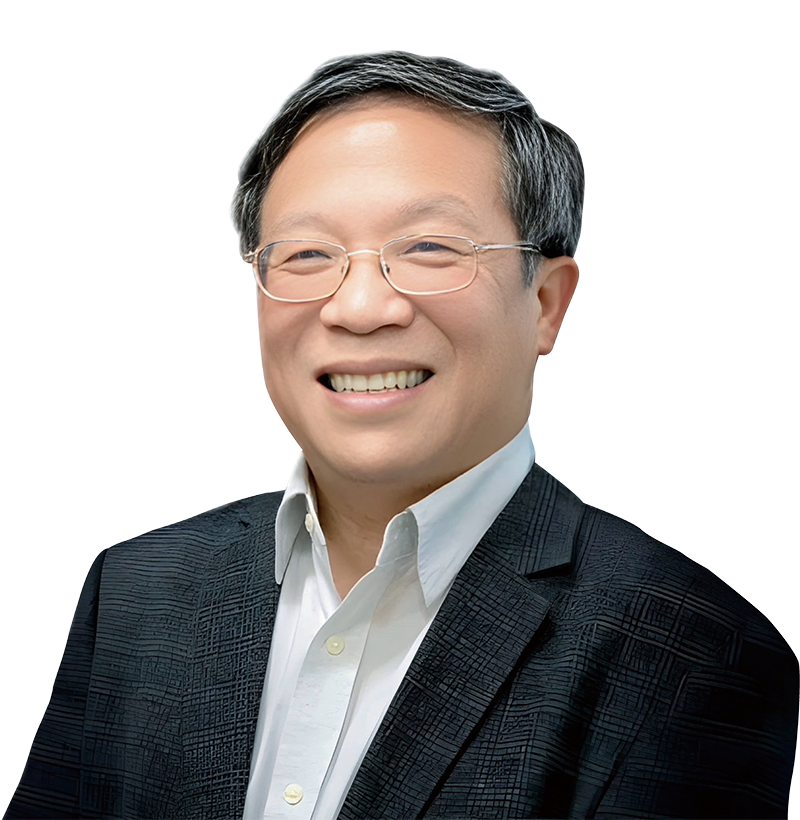
Distinguished Professor, Department of Physics, National Taiwan University
Director, Quantum Information Center, Chung Yuan Christian University
Chairman, Taiwan Association of Quantum Computing and Information Technology Ching-Ray Chang
The NISQ Era
Driving a Practical Revolution with Qubits
Quantum technology is at a critical juncture, transitioning from scientific research into engineering development and industrial application. While businesses widely expect 2027 to be a pivotal commercial turning point, progress must be assessed based on hardware maturity.
The current quantum technology is supported by three pillars. The first is quantum communication, which has advanced most rapidly and has begun commercial deployment. The second is quantum sensing, which continues to deliver niche, high-precision utility in specialized sectors. The third, quantum computing, remains the most broadly transformative yet technically challenging. Its promise lies in its capacity to transform the way traditional industries compute and unlock deeper mysteries of nature. Yet, because qubits are inherently fragile and achieving scalable quantum control is difficult, fault-tolerant quantum computation (FTQC) remains one of the most formidable bottlenecks of the modern era.

We currently operate within the NISQ (Noisy Intermediate-Scale Quantum) era, characterized by qubits that are noisy and error‑prone, with errors accumulating as circuits deepen. While physicists strive for perfection, investing heavily to raise single‑qubit reliability from 99.99% to 99.9999% or beyond, the R&D costs are prohibitively high. By contrast, the engineering community is taking a pragmatic path. This involves combining existing imperfect qubits to address problems solvable with today’s technology, bringing products to market for feedback, and thereby sustaining industry growth.
In the NISQ era, quantum computers cannot handle mathematical or physics problems that demand 100% precision. Consequently, R&D focus has shifted toward application areas that are highly error‑tolerant and where quantum computers can operate more efficiently than classical computers.
For instance, in the biopharmaceutical sector, quantum computers can help search through tens of thousands of molecular combinations to identify potential drugs. The objective is not necessarily to find a single optimal solution; even a second‑best, usable formula carries significant R&D value. In financial investment, quantum computers need only generate a stable, profitable portfolio within an extremely short time frame, even if it does not yield the maximum possible return, to realize a clear commercial advantage.
Quantum and classical computers, by complementing each other’s strengths, can generate even greater benefits.
When the scale and complexity of computational problems exceed a certain threshold, classical computers falter under exponential growth in workload. By contrast, quantum computers possess the capacity to process massive datasets almost instantaneously. Once the two are seamlessly combined, it is akin to equipping a precise navigation blueprint with a jet engine. Enterprises will be empowered to tackle complex challenges in drug development or financial risk management ahead of full quantum maturity.
To realize this fusion of classical and quantum computing, a number of enabling technologies have emerged. One example is the development of quantum algorithms, such as quantum annealing or the quantum approximate optimization algorithm (QAOA), designed to search for optimal solutions within a large number of possible configurations. In these hybrid designs, a classical computer iteratively adjusts parameters to guide the quantum computer in finding correct answers despite noise interference, forming an archetypal model of quantum‑classical convergence.
While this approach can readily handle small‑scale problems, achieving enterprise‑level applications requires the ability to process large‑scale data.
Currently, academic researchers in Taiwan have successfully applied these algorithms to portfolio analysis using three decades of financial data. Research shows that as portfolio complexity exceeds 20 assets, traditional computers struggle to perform real‑time risk management. By contrast, quantum algorithms have demonstrated in historical simulations the ability to generate portfolios with higher returns and lower risk than the market. Financial institutions are already in discussions to commit capital for pilot testing, and if quantum computing proves stable, the prospect of automated quantum trading could become a reality.
Furthermore, spintronics, leveraging the properties of electron spin to develop low‑power, highly stable hardware, can provide energy‑efficient, cryogenic‑resilient control systems. These systems help quantum hardware and classical computers integrate and operate efficiently, making spintronics a key enabler for large‑scale quantum‑classical convergence.
Although mainstream hardware has yet to fully adopt spintronic technology and commercialization costs remain high, a growing number of startups have begun to explore this path.
Against this backdrop, the Quantum Computing Research Center and Trapped-Ion Quantum Computing Laboratory have overcome geographical barriers to recruit top global talent and strengthen their international competitiveness. Looking ahead, I recommend deeper dialogue with Hon Hai Technology Group’s business units so that research directions align more closely with corporate strategy. This would enable theoretical research to be transformed into the Group’s competitive edge.