Artificial Intelligence Research Center Mastering Technological Autonomy and Sustainable Computing to Drive Transformation in EVs and Smart Manufacturing
The AI revolution is sweeping across the globe. It serves as a core driver of Hon Hai Technology Group’s 3+3 Strategy, which encompasses three emerging industries (Electric Vehicles, Digital Health, and Robotics) and three key technologies (Artificial Intelligence, Semiconductors, and Next-Generation Communications).
In 2025, the Artificial Intelligence Research Center achieved landmark breakthroughs across three major research frontiers: FoxBrain, an internally developed reasoning engine attuned to Taiwan’s sociolinguistic context; EV sensing technologies capable of precise prediction under extreme conditions; and Spiking Neural Networks (SNNs) that push the limits of energy efficiency. These three technologies not only underscore the Institute’s competitiveness in leading international academic circles but also highlight the Group’s deep commitment to pioneering frontier AI.
Developing FoxBrain: A Traditional Chinese LLM Capable of Reasoning
Amidst the fierce global competition in Large Language Models (LLMs), the Hon Hai Research Institute has chosen an ambitious yet strategically vital path: independently developing and training its own LLM, FoxBrain.
Behind this decision lies a highly pragmatic consideration: linguistic and cultural autonomy. Over-reliance on global models risks marginalizing Taiwan’s unique linguistic and cultural nuances. Currently, most Chinese-language corpora used in international models are based on Simplified Chinese, resulting in insufficient coverage and frequent biases regarding Taiwan’s localized knowledge, distinct vernacular, and core values. In addition, cybersecurity risks are a paramount concern. As enterprises seek to deeply integrate AI into their production workflows, relying on foreign cloud services necessitates transmitting core data to overseas servers. It is an unacceptable risk for a manufacturing sector that prioritizes patents and privacy.
The development of FoxBrain addresses the growing demand for on-premise deployment. Capable of operating entirely offline, FoxBrain safeguards core technologies while building unique, domain-specific datasets during training.
What truly sets FoxBrain apart from pre-2025 LLMs is its distinct reasoning capability. In the field of autonomous driving, traditional algorithms were largely rule-based and often defaulted to rigid emergency stops when faced with undefined scenarios. FoxBrain, however, functions much like a human brain, equipped with Chain-of-Thought (CoT) reasoning. For instance, if a vehicle encounters temporary roadwork where traffic cones direct it across a double yellow line, a traditional model might freeze in place to avoid a traffic violation. FoxBrain, however, uses scene-based logical deduction to flexibly navigate around the obstacle, just as a human driver would. When predicting pedestrian behavior, it goes beyond merely tracking paths; it perceives pedestrian intent and preemptively executes defensive maneuvers such as slowing down.
Currently, FoxBrain’s objective is to become the model that best understands manufacturing. By collecting images and operational data from physical robots on factory floors, FoxBrain is evolving into a Vision-Language Model (VLM). In the future, it will be capable of directly interpreting defect images on production lines or roadway visuals during vehicle operation.
In the medical field, our research team has leveraged Retrieval-Augmented Generation (RAG) and Knowledge Graph technologies to successfully mitigate AI hallucination issues. This ensures that generated medical advice strictly adheres to clinical guidelines, enabling the model to serve as an intelligent co-pilot for physicians and helping bridge the information gap between doctors and patients.
Multimodal Sensing Breakthroughs for Autonomous Driving’s Long-Tail Problems
Although AI has become a prominent field of study, the greatest hurdle to deploying autonomous driving in the real world lies in long-tail problems, which are extremely rare but potentially fatal extreme scenarios. In 2025, the AI Research Center redefined the boundaries of vehicle perception and prediction through two technologies that captured first place in international competitions.
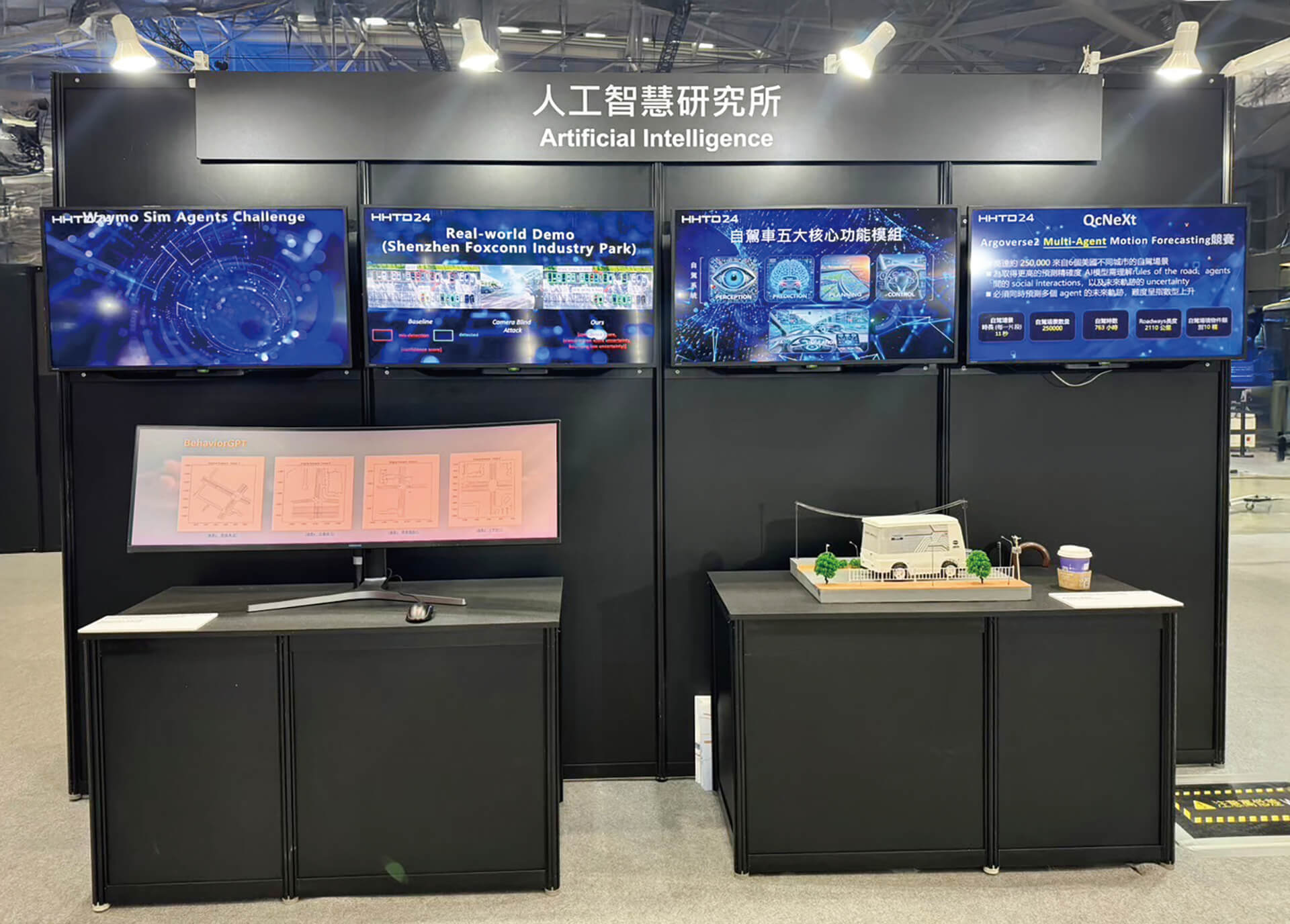
The first breakthrough was demonstrated at the Waymo Open Motion Prediction Challenge. The Center’s key to winning this competition was its multi-trajectory prediction capability. Human driving intentions are highly complex; at an intersection, a driver might proceed straight, turn left, or wait. The Center’s algorithms can simultaneously predict multiple potential paths. If a sudden event disrupts the primary choice, the system can instantly switch to an alternative route to avoid danger.
An extended application of this technology is the creation of highly realistic virtual environments. By simulating a diverse array of dangerous driving behaviors, autonomous models can undergo tens of thousands of hours of rigorous training within a virtual world. This approach is not only safer and more efficient than physical road testing, but it also teaches the AI how to handle unpredictable traffic scenarios and chaotic road conditions.
To overcome poor visibility scenarios such as heavy rain, dense fog, and low-light nighttime conditions, the Center developed Guided Thermal Super-Resolution (GTSR), a breakthrough that earned first place in the Thermal Image Super-Resolution Challenge at CVPR 2025. This core technology fuses RGB imagery with thermal sensing to leverage the strengths of both modalities. Thermal imaging captures heat signatures, while RGB imagery provides fine details and textures, such as leaf edges and traffic light contours, enabling vehicles to accurately detect and recognize targets even in completely dark environments.
In addition, the MARE technology, recognized at AAAI 2025, was specifically developed to solve the long-tail object problem that traditional perception models struggle to process. The Center pioneered the transformation of Tesla’s Occupancy Network concept into the MARE algorithm, which features 3D reconstruction capabilities. By breaking the reliance on expensive LiDAR systems, the Center proved that a single camera, combined with advanced semantic scene understanding, can accurately determine drivable space in complex environments, creating a new paradigm for low-cost autonomous perception.
Furthermore, MARE technology can reconstruct full 3D scenes in real-time. By introducing the concept of a memory bank, the system can rebuild scenes from stored information even when objects are temporarily obscured. This single-camera Semantic Scene Completion (SSC) approach enables Hon Hai to deliver navigation performance comparable to high-end sensors at a fraction of the hardware cost, giving electric vehicle development a significant competitive advantage.
Quick Glossary
LiDAR
LiDAR is a remote sensing technology that uses pulsed laser light to measure the time of flight of reflected signals. It is widely used in autonomous vehicles, forestry, and archaeology.
SNNs Grant Edge AI “Biomimetic” Endurance
While the world worries about AI becoming a power-hungry monster, the Center is dedicated to developing Spiking Neural Networks (SNNs) that are as energy-efficient as the human brain. SNNs transmit signals using discrete spikes, making them far more power-efficient and biomimetic than traditional deep learning models such as Convolutional Neural Networks (CNNs) and Transformers.

In the past, efforts to shorten simulation times to lower energy consumption often led to performance degradation due to insufficient information and vulnerability to noise. Research published by the Center in IEEE Transactions on Pattern Analysis and Machine Intelligence introduces a fundamental solution: Dynamic Capacity Experience Replay. If the AI brain is likened to a learner, this mechanism acts as an intelligent memory manager, automatically filtering and retaining high-quality experiences while discarding noisy, low-quality data.
This innovation shatters a long-standing trade-off in the AI field: the notion that making hardware smaller and more energy-efficient inevitably leads to a severe compromise in learning performance. Through this mechanism, AI can learn stably under extremely low power consumption, which is crucial for Edge AI. Although local edge computing power cannot currently compete with the massive scale of tens of thousands of GPUs used by cloud giants, the Center is seeking new breakthroughs through a paradigm shift in algorithms. This means that future factory inspection robots, agricultural drones, or in-vehicle chips will be able to sustain longer periods of autonomous learning and decision-making without relying on cloud computing resources.
It is worth noting that the parameters of existing AI models typically become fixed once training is complete, meaning that learning new tasks requires retraining. However, the goal of SNN research is to achieve continuous learning and lifelong learning. In this approach, the model can evolve during inference, much like a human who continues to absorb new knowledge long after finishing a book.
Once SNNs can be scaled up to hundreds of billions of parameters and paired with dedicated neural network chips, the next generation of AI systems will become both intelligent and energy-efficient.
These three major technologies are deeply interconnected: FoxBrain provides advanced reasoning and decision-making, multimodal perception technology grants vehicles high-precision vision, and SNN technology ensures that all computations run efficiently under low energy consumption. Yung-Hui Li, Director of the Artificial Intelligence Research Center, emphasized that this research is not only aimed at enhancing the competitiveness of Hon Hai Technology Group’s products and solutions but also at strengthening Taiwan’s overall AI capabilities. It is about safeguarding technological autonomy, cultivating cutting-edge local talent, and collaborating across Taiwan’s industries to secure a decisive voice in the global AI landscape.