Trapped-Ion Quantum Computing Laboratory From Precise Control to High-Efficiency Readout Paving the Way Toward a Scalable Commercial Future
With the global quantum computing race intensifying, the Trapped-Ion Quantum Computing Laboratory has, since its founding in 2021, focused on building a high-quality qubit control environment, with stable ion arrays as its central research objective. By 2025, the Laboratory achieved significant breakthroughs in hardware architecture, ion cooling, single-shot readout fidelity, and preliminary quantum manipulation. These milestones not only validate key technologies but also demonstrate that Hon Hai Technology Group now possesses the independent capability to seamlessly integrate quantum computing hardware and software.
As a hardware platform for quantum computing, trapped-ion systems utilize natural atoms as qubits. Because these atoms have inherently identical physical properties, they do not depend on the precision manufacturing processes required by artificial qubits (such as superconductors or semiconductors) to improve yield. This eliminates the need for costly calibration of minute component variations and underscores a unique advantage in qubit quality.
Among the many quantum computing platforms, including superconducting qubits, photonics, and neutral atoms, what truly distinguishes trapped-ion systems is their exceptional coherence times and low error rates. Qubit coherence is a critical metric used to measure how long quantum information can be preserved without disruption from environmental noise. While superconducting qubits typically exhibit coherence times on the order of milliseconds, ion qubits can remain coherent for several seconds and, under specific conditions, for several hours. This long-term stability is essential for executing quantum algorithms with complex structures and deep computational requirements.
Quick Glossary
Linear Coulomb Crystal
A stable physical structure formed by cooling multiple ions to extremely low temperatures. In this state, mutual Coulomb repulsion balances with the external electric field of the ion trap, holding ions at fixed intervals to serve as fundamental quantum computing units.
Ytterbium-171 Ions and the Linear Paul Trap
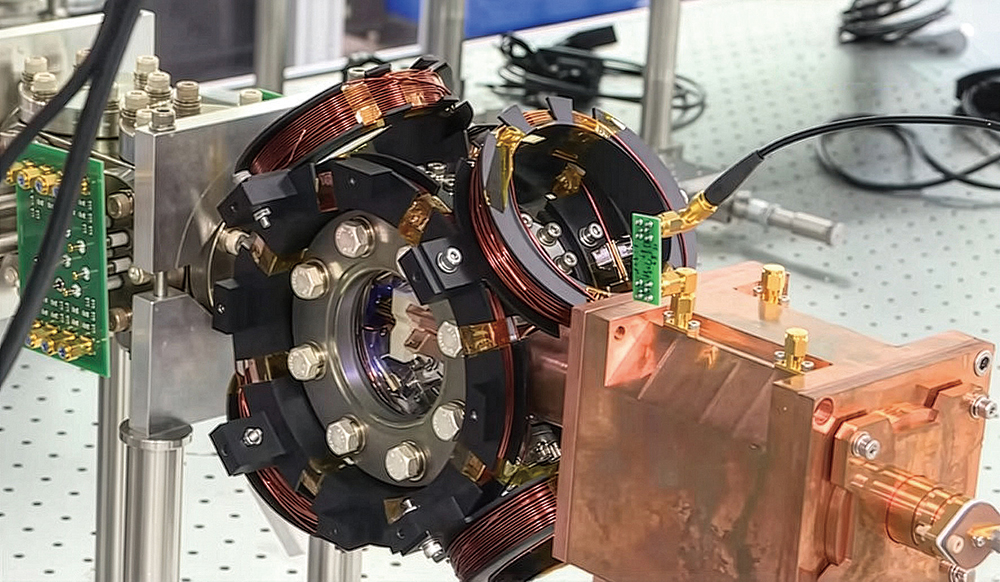
One of the Laboratory’s primary research achievements in 2025 was establishing a technological pathway that pairs a linear Paul trap with Ytterbium-171 (Yb-171) ions.
Ytterbium is a rare-earth metal in the lanthanide series, with two electrons in its outermost shell. The team vaporizes bulk ytterbium metal to form an atomic gas and, through photoionization, strips away one of these outer electrons. This process produces a positively charged ion, which is then confined within the trap by an alternating electric field applied to the electrodes. At this stage, the ion retains only a single outer electron, simplifying its energy-level structure. This reduction in complexity lowers the demands and cost of laser control while enhancing precision in qubit manipulation.
The main reason for selecting the Yb-171 ion is its low sensitivity to external magnetic field interference. This level of technological precision parallels high-fidelity experiments such as atomic clocks, ensuring that the qubits remain stable and resistant to information errors caused by minute environmental fluctuations during computation.
Doppler Cooling and Linear Coulomb Crystal
For an ion to serve as a viable qubit, it must first be effectively “frozen” in space. To achieve this, the Laboratory uses Doppler laser cooling technology to bring ions to near absolute zero. In this extreme ultra-cold environment, the Coulomb repulsion between ions balances against the external trapping fields, forming a stable linear Coulomb crystal structure.
Under an optical microscope, these trapped ion arrays resemble strings of pearls, with ions aligning sequentially and separated by several micrometers. This system currently demonstrates extraordinary stability. The Laboratory estimates that the ions can remain confined in the trap for several days or even longer, providing a robust platform for extended quantum experiments.
Achieving 99.67% High-Fidelity Readout
Readout is the final and most critical step in quantum computing. If computational results cannot be accurately extracted, even the most precise prior operations become meaningless. Experimental data shows that the Laboratory has achieved a single-shot readout fidelity of 99.67%. This indicates that State Preparation and Measurement (SPAM) errors have been suppressed to exceptionally low levels.
In fluorescence detection histograms, the Laboratory observed a clear separation in photon count distributions representing the dark state (State 0) and the bright state (State 1). Initially, background system noise limited the optimal threshold to around eight counts. More recently, however, through optical system optimization, the Laboratory successfully reduced the optimal threshold to between three and four counts, enabling more reliable state discrimination.
Quick Glossary
Optimal Threshold
The optimal threshold is the benchmark used to distinguish between a qubit’s bright and dark states. By analyzing the statistical distribution of photon counts, researchers determine the precise cut-off point that minimizes readout error. When the detected photon count exceeds this threshold, the qubit is identified as being in the bright state. By accurately setting this photon-count threshold, the Laboratory has minimized readout errors and achieved a single-shot fidelity of 99.67%.
This improvement stems from several technical advances. First, the signal-to-noise ratio (SNR) was enhanced by employing a high-numerical-aperture (high-NA) lens system, which increased the efficiency of capturing ion fluorescence. Second, scattered light was reduced by refining shielding and optical designs to prevent stray light caused by lasers striking trap hardware from reaching the detector. Finally, the use of photomultiplier tubes (PMTs) for high-sensitivity signal acquisition further strengthened the system’s performance.
Precise Coherent Manipulation and Rabi Oscillations
In addition to readout, the ability to command ions to perform calculations is equally crucial. The Laboratory has successfully observed clear Rabi oscillations with exceptionally low decay rates. A Rabi oscillation is the process by which a qubit evolves between states 0 and 1 in response to the duration of a driving pulse. When this oscillation appears as a stable, low-decay sine wave pattern, it shows that the research team has achieved highly precise control over the evolution of the quantum state.
Successfully generating Rabi oscillations provides the critical foundation for precise single-qubit operations (such as the X gate and H gate). It demonstrates that the experimental system possesses long coherence times and provides a more generous fault-tolerance margin for implementing increasingly complex single-qubit logic gates in the future.
Charting a Course Toward Scalability and Chip Integration
In anticipation of the growing demand for increased qubit counts, the Laboratory has proactively designed multiple generations of hardware systems. The first-generation hardware architecture employed a single-zone blade design, primarily for basic ion capture. The second-generation system currently under development introduces a multi-zone structure built on silicon carbide (SiC) wafers with precision circuit designs. This innovative 2.5D structure, bridging conventional bulky 3D setups and fully planar chip integration, enables ions to shuttle between different zones. Ions designated for entanglement can be moved into dedicated computation zones to execute logic gates, while idle ions can be relocated to reduce interference with active qubits.
Looking forward, the objective for the third generation is a true chip-scale ion trap. Conventional systems rely on large optical tables to guide lasers, which severely limits commercialization. The Laboratory is integrating silicon photonics technology, aiming to embed waveguides directly onto silicon substrates. This architecture would allow light to propagate internally within the chip and be precisely focused upward onto suspended ions.
Currently, in partnership with National Yang Ming Chiao Tung University, the Laboratory has successfully developed an on-chip integrated control light source. This technology employs silicon nitride waveguides to realize a non-local visible-light metasurface equipped with both phase and amplitude control. Ultimately, it is expected to replace bulky free-space optical setups, enabling high-precision, addressable qubit manipulation and laying the core technological foundation for the large-scale expansion and modular commercialization of trapped-ion quantum computers.
For the Laboratory, 2025 marked a pivotal foundational year, establishing a clear development roadmap. The primary focus for 2026 will be the deployment of a Raman laser system to implement critical two-qubit logic gates and ion entanglement experiments. The overarching goal is to unveil a programmable quantum computer prototype featuring 5 to 10 qubits by 2027.
“In 2024, we succeeded in trapping ions, but trapping alone does not grant control of the ions’ quantum states. In 2025, our efforts focused on mastering precise state control, ensuring that each ion functions as a high-quality qubit,” notes Guin-Dar Lin, Director of the Trapped-Ion Quantum Computing Laboratory. By continuously optimizing optical paths, rigorously suppressing environmental noise, and integrating semiconductor manufacturing processes, the Laboratory is advancing steadily toward the commercialization of quantum technology.