Information Security Research Center Forging a Global Collaborative Defense Deepening AI Security and Post-Quantum Resilience
In the complex cybersecurity landscape of 2025, human-centric defense alone was no longer a viable safeguard to counter escalating threats. The Information Security Research Center is focused on mitigating risks from the malicious exploitation of AI and failures in AI decision-making. The Center’s strategic initiatives range from pioneering Computing-in-Memory (CIM) architectures to overcome the performance barriers of Post-Quantum Cryptography (PQC) to exposing collision-detection vulnerabilities in autonomous driving simulators that had previously gone unnoticed even by official developers.
Safeguarding AI in Mission-Critical Environment
As generative AI and autonomous vehicle systems move from experimental stages into mission-critical applications such as writing code, planning vehicle routes, and even making decisions, their inherent vulnerabilities are magnified. The Center has systematically revealed AI security risks in real-world scenarios and developed robust defense methods supported by quantifiable indicators.
First, the Center instituted a continuous defense cycle through rigorous red and blue team exercises. Traditional red teaming is often manual, cost-prohibitive, and limited in scope. In response, the Center developed an automated red-teaming framework driven by intrinsic motivation and autonomous exploration. This system can automatically identify vulnerabilities in black-box environments without requiring access to a model’s internal parameters. Research confirms that this approach increases the thematic diversity of adversarial datasets by 41%. In addition, to counter cross-modal jailbreak attacks, the Center engineered a blue-team suffix-based prompt defense module. This tool automatically generates protective text, reducing attack rates by 50% to 73%. These innovations have already been partially integrated into the FoxBrain platform as a frontline security layer.
Quick Glossary
F1 Score
The F1 Score is a comprehensive metric used to evaluate the classification performance of an AI model. It combines precision (avoiding false positives) and recall (avoiding false negatives), requiring both metrics to be high to achieve a strong overall score.
In smart manufacturing, engineers use AI to assist in code generation. However, if AI-generated code contains hidden vulnerabilities or backdoors, it could lead to severe industrial equipment failures and major financial losses. Traditionally, patching such vulnerabilities requires costly model retraining, which may also degrade the model’s original capabilities. To address this, the Center developed a training-free model patching technology. By precisely adjusting internal safety parameters, this method enhances security by 10% without affecting existing functionality. In addition, to prevent attackers from embedding malicious triggers in training data, the research team developed a new algorithm that analyzes the unnaturalness and abruptness of text passages to detect anomalies. This approach successfully raised defense accuracy to 87%, providing more comprehensive cybersecurity protection for AI-assisted development.
Apart from smart manufacturing, the Center has invested heavily in the safety-critical field of autonomous driving, conducting comprehensive research into both perception and planning layers. Investigating system vulnerabilities, the research team revealed security concerns in online high-precision mapping models. Experiments showed that targeted lighting or physical patch attacks could reduce mapping accuracy by 9.9% and cause up to 44% of route-planning failures. To strengthen system robustness, the Center proposed a root-cause analysis method for multi-sensor fusion systems integrating LiDAR, radar, and cameras. When multiple perception modules fail simultaneously, this technique can pinpoint the fault source with an F1 score above 95%, enabling engineers to debug quickly and effectively.
In addition, the team conducted an in-depth analysis of CARLA, the industry-standard autonomous driving simulator. By developing a cuboid-based modeling detection method, they successfully identified 20 times more undetected collision scenarios than earlier approaches. This breakthrough was later confirmed by the official CARLA development team and assigned a CVE vulnerability ID (CVE-2024-33903). This achievement marks a major contribution to enhancing the safety of international autonomous driving simulation technologies.
PQC + CIM: Eliminating Memory and Energy Bottlenecks
Parallel to the rapid evolution of AI, quantum computing technology is also advancing at an accelerated pace. As quantum computing develops, traditional public-key cryptosystems face the risk of being compromised, making Post-Quantum cryptography (PQC) a critical safeguard for information security. The Center has focused its R&D on the latest FIPS-203 ML-KEM standard released by the U.S. National Institute of Standards and Technology (NIST). However, the heavy reliance on high-degree polynomial multiplications within ML-KEM has become one of its key performance bottlenecks.
To overcome these constraints, the research team performed deep, hardware-oriented optimizations of the core Number Theoretic Transform (NTT) algorithm. By restructuring the underlying mathematical logic, the team successfully reduced computational complexity, laying a high-efficiency foundation for subsequent hardware integration.
In traditional von Neumann architectures, frequent data movement between the processor and memory causes latency and high energy consumption, a phenomenon commonly referred to as the memory wall. To address this, the Center collaborated extensively with the Industrial Technology Research Institute (ITRI) to introduce a disruptive Computing-in-Memory (CIM) architecture.
The core of CIM lies in embedding processing units directly within the memory array, enabling in-situ computation and eliminating the overhead of data movement. While CIM is an established architectural concept, the Center’s application of it to accelerate PQC systems represents a pivotal transition from theoretical research to engineering implementation. Experimental results show that, within the same chip area, combining NTT optimization with CIM architecture delivers a 14.22x performance increase over traditional software-based implementations.
Quick Glossary
FPGA
A Field-Programmable Gate Array (FPGA) is a semiconductor component that, even after being manufactured, allows users to repeatedly reconfigure its internal hardware circuit structure using code.
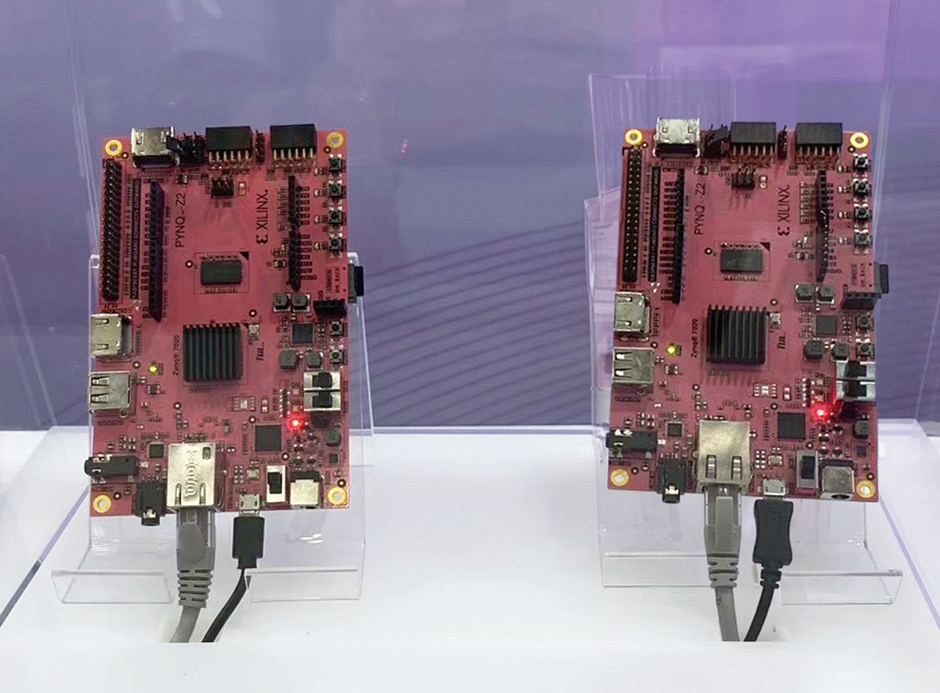
This technology has successfully transitioned from theory to practical implementation. A Proof-of-Concept (PoC) of the ML-KEM algorithm was completed on the development board by SiliconAuto, an IC design subsidiary of Hon Hai Technology Group. This demonstrated the technology’s ability to directly empower smart in-vehicle environments. In addition, FPGA validation confirmed that while pursuing high performance, the correctness of the cryptographic operations fully complies with the NIST FIPS-203 international standard. Both of these R&D achievements were officially unveiled at Hon Hai Tech Day 2025, garnering high praise from industry experts.
Global Cybersecurity Governance: Implementing a Collaborative Defense System
To address Hon Hai Group’s cross-disciplinary and multi-site global footprint, the Center is committed to transforming cybersecurity defense into a driver of corporate governance, establishing information security as a pivotal element in the Group’s sustainable development.
The foremost objective in implementing cybersecurity governance is cultivating executive accountability. Through the operations of the Cybersecurity Governance Committee, chairmen and presidents of the Group’s subsidiaries have actively participated in core cybersecurity decision-making. Their involvement not only strengthens strategic execution but also ensures top-down alignment, effectively mitigating the communication friction and risks caused by inconsistent standards.
This year, the Center officially integrated the Cyber Defense Matrix (CDM) into the Group’s operations, aligning it with the NIST CSF (Cybersecurity Framework) to construct a comprehensive, visualized defense roadmap. This structured approach allows management to intuitively identify protection gaps and resource allocation status. By translating technical metrics into executive-level decision logic, the Center bridges the gap between engineering and management teams to ensure seamless communication. This mechanism has not only refined cybersecurity budget auditing but also catalyzed centralized procurement strategies, optimizing investment returns and enhancing defense resilience while reducing costs.
Regarding cybersecurity incident response, the Center has moved beyond traditional documentation and drills by co-developing a Cybersecurity Incident Response Dashboard with IT departments. This embodies the Code as SOP philosophy, transforming complex standard operating procedures into code-driven, automated workflows. This initiative significantly improves execution efficiency, prevents the omission of critical steps, and ensures a consistent, high-standard baseline throughout the response process.
Reflecting on 2025, the Information Security Research Center demonstrated a comprehensive strategy ranging from low-level structure to high-level strategy. Key breakthroughs were achieved in PQC, AI security, and cybersecurity governance. These advances not only boosted PQC performance but also safeguarded smart manufacturing and autonomous driving systems against AI threats while establishing a robust cross-regional governance framework. Wei-Bin Lee, CEO of the Hon Hai Research Institute and Director of the Information Security Research Center, emphasized that future strategic development will continue to focus on these three pillars. By accelerating research into PQC standards, strengthening automated AI defense, and ensuring global governance consistency, the Center aims to build a resilient security perimeter for the Group in an era shaped by the twin forces of AI and quantum technology.